Alan Galey
Associate Professor Contact:
alan.galey [at] utoronto [dot] ca
Alan Galey
Faculty of Information
140 St George St.
University of Toronto
Toronto, Ontario
Canada M5S 3G6
Bio
Alan Galey is Associate Professor in the Faculty of Information at the University of Toronto, cross-appointed to the Department of English, and former director of the collaborative program in Book History and Print Culture. His research and teaching are located at the intersection of media studies, the history of books and reading, and digital textual scholarship. His current research focuses on methods for the bibliographical study of digital texts and artifacts, from ebooks to videogames to digital recordings of musical performances.
His current primary research is a project called Bibliographic Methods for Born-Digital Texts: From Paratext to Performance, funded from 2018 to 2022 by an Insight Grant from the Social Sciences and Humanities Research Council of Canada (SSHRC). The primary result of this project will be a book-length study tentatively titled The Veil of Code: Studies in Born-Digital Bibliography. For more details, see the project's blog. His secondary projects include a set of open-source digital prototypes titled Visualizing Variation, and the digital book history project Architectures of the Book (archbook.ca). He also serves as digital advisor on the upcoming fourth series of the Arden Shakespeare editions, and on several Folger Shakespeare Library projects.
His first monograph book, The Shakespearean Archive: Experiments in New Media from the Renaissance to Postmodernity, was published in 2014 by Cambridge University Press. He has published articles in journals including Book History, Shakespeare Quarterly, the Canadian Journal of Communication, Literary and Linguistic Computing, Archivaria, and Archival Science. He has also contributed chapters to several scholarly edited collections, and co-edited Shakespeare, the Bible, and the Form of the Book: Contested Scriptures (with Travis DeCook; Routledge, 2011). His article "The Enkindling Reciter: E-Books in the Bibliographical Imagination," published in Book History in 2012, was awarded the Fredson Bowers Prize by the Society for Textual Scholarship. In 2016 he co-curated, with Scott Schofield, Peter Blayney, and Marjorie Rubright, an exhibition at the Thomas Fisher Rare Book Library titled "'So Long Lives This': Celebrating Shakespeare 1616-2016," whose catalogue won the 2017 Leab Exhibition Award from the Association of Research and College Libraries.
Research As sole author unless otherwise noted
Bibliographic Methods for Born-Digital Texts: From Paratext to Performanceongoing
The past few years have seen remarkable growth in textual scholarship that does not simply apply digital tools to the study of texts, but rather takes digital textuality itself as the object of study. What might an artifact like an e-book reveal about the history and social contexts of its making, or the collaborative nature of its construction? How do we locate the significant differences between the surviving versions of a digital musical recording or videogame, and what is at stake in their preservation and representation? Bibliography and other forms of textual scholarship are uniquely positioned to illuminate the human acts of construction in our increasingly born-digital cultural heritage, but need to adapt their methods, vocabularies, and theoretical frameworks to understand born-digital texts. On that premise, my current book project extends bibliographical questions and methods to several case-studies of born-digital textual artifacts, from e-books, to web browsers, to digitally curated recordings, to video games and other forms. The project is supported by a SSHRC Insight Grant (2018-2022); for more details, see the project's blog.
Related publications:
- Alan Galey and Ellen Forget. "Video Games with Footnotes: Understanding In-Game Developer Commentary." (Not) In the Game: History, Paratexts, and Games. Ed. Ed Vollans and Regina Seiwald. Berlin: De Gruyter, 2023. [forthcoming, in production]
- "Behind the Scences at ApertureScience.com: Portal and Its Paratexts." Games and Culture.
- This article is part of a cluster on the topic "Video Games and Paratextuality," for which I'm also the editor. It will appear in a future issue of the journal along with other articles on the topic, but for now it's available on its own through the journal's online first publication stream: https://doi.org/10.1177/15554120221106927M
- "Imagining Marshall McLuhan as a Digital Reader: an Experiment in Applied Joyce." In "Reading McLuhan Reading,"" ed. Paula McDowell, special issue, Textual Practice 35, no. 9 (2021): 1525–49
- open-access version
- accompanying post on my blog veilofcode.wordpress.ca
- "The Work and the Listener." Textual Cultures 14, no. 1 (2021): 50–64
- "Analyzing E–books in the Age of Digital Locks: Challenges and Strategies, in Books.Files: Preservation of Digital Assets in the Contemporary Publishing Industry, by Matthew Kirschenbaum et al., (College Park, MD, and New York, NY: University of Maryland and the Book Industry Study Group, 2020), 40–42
- "Looking for a Place to Happen: Collective Memory, Digital Music Archiving, and The Tragically Hip." Archivaria 86 (2018): 6-43.
- open-access version
- accompanying post on my blog veilofcode.wordpress.ca including images and audio that couldn't be included in the article
- "Five Ways to Improve the Conversation About Digital Scholarly Editing." Invited article-length blog post for the Modern Language Association’s Committee on Scholarly Editing (posted 2 August 2016): https://scholarlyeditions.commons.mla.org/2016/08/01/five-ways-to-improve-the-conversation-about-digital-scholarly-editing/
- "The Enkindling Reciter: E-Books in the Bibliographical Imagination." Book History 15 (2012): 210-47.
- awarded the Fredson Bowers Prize by the Society for Textual Scholarship
- open-access post-print version
- "Reading the Book of Mozilla: Web Browsers and the Materiality of Digital Texts." The History of Reading, Vol. 3: Methods, Strategies, Tactics. Ed. Rosalind Crone and Shafquat Towheed. New York: Palgrave Macmillan, 2011. 196-214.
Related presentations:
- "Digital Files, Digital Books, and the Bibliographical Dimensions of Format Theory." Society for the History of Authorship, Reading, and Publishing (SHARP) Annual Conference, held online due to COVID-19, 26 July.
- "'You Really Shouldn’t Be Here': Backstage in the Portal Games." Canadian Game Studies Association (CGSA) Annual Conference, held online due to COVID-19, 4 June.
- "In the Borderlands of Copyright: E-Books, Evidence, and the Future of Digital Bibliography." Society for the History of Authorship, Reading, and Publishing (SHARP) Annual Conference, University of Massachusetts, Amherst, 17 July 2019.
- "The Sea of Doors: Navigating Video Games in Variant Versions." Canadian Game Studies Association Annual Conference, Congress of the Humanities and Social Sciences, University of British Columbia, Vancouver, 7 June 2019.
- "Subterranean Algorithmic Blues: Textual Criticism, Digital Formats, and Bob Dylan’s 'Bootleg Series.'" Society for Textual Scholarship Conference, New School, New York City, 22 March 2019.
- "Bibliography for a Used Future: What Bibliographical Methods Can Teach Us About Digital Artifacts (and Vice Versa)." Bibliography Among the Disciplines Conference. Rare Book School. Philadelphia, PA, 13 October 2017.
- "Looking for a Place to Happen: the Archival Practices of Music Bootlegging Communities." Plenary lecture for the Archival Education and Research Institute (AERI), University of Toronto, 13 July 2017.
- "Portal's Hidden Paratexts: Analytical Bibliography and the Study of Videogames." Society for Textual Studies (STS) Conference, University of Maryland, College Park, MD, 2 June 2017.
- Closing remarks for "Preserving Popular Music in Canada." Panel discussion moderated by Denise Donlon, with Alex Lifeson (Rush), Lorraine Segato (Parachute Club), Rob Bowman, and Marty Melhuish. University of Toronto Libraries, Innis College Town Hall, 17 May 2016.
- "Textual Scholarship in the Wild: the Digital Curation of Bootleg Concert Recordings." Society for Textual Scholarship (STS) Conference, Ottawa. 15 April 2016.
- "Bibliography for a Used Future: Finding the Human Presence in E-Books and other Digital Artifacts." Toronto Centre for the Book / iSchool Colloquium Series, University of Toronto, 24 March 2016.
- "Ripples on the Surface: Reading Digital Books as Artifacts." History of the Book Seminar, Harvard University, 6 October 2015.
- "Bibliography Beyond Books: Digital Artifacts, Bibliographical Methods, and the Challenge of 'Non-Book Texts.'" Society for the History of Authorship, Reading, and Publishing (SHARP) Annual Conference, McGill University Montréal, 10 July 2015.
- "Veils of Print and Veils of Code: the Challenge of Understanding Digital Texts Bibliographically." Washington Area Group for Print Culture Studies, Library of Congress, Washington, DC, 6 February 2015.
- "The Bibliographic Study of Born-Digital Texts." Joint keynote address for the conferences of the Bibliographical Society of Canada (BSC) and the Canadian Association for the Study of Book Culture (CASBC), CFHSS Congress, St Catherine’s, ON, 27 May 2014.
- "The Veil of Code: Born-Digital Texts and Future Prospects for Digital Textual Scholarship." Society for Textual Scholarship Conference, University of Washington, Seattle, 21 March 2014.
- "Fahrenheit 2,570: Ray Bradbury and the Dangerous Materiality of Books." Public lecture co-sponsored by the Toronto Public Library's "Keep Toronto Reading" Festival. University College, University of Toronto, 4 April 2013.
Visualizing Variationongoing
Visualizing Variation is an open-source code library of prototype interface components for digital scholarly editing and visualization, one of the outputs of my SSHRC Standard Research Grant project, Archive and Interface in Digital Textual Studies (see below).
Related publications:
- Alan Galey and Rebecca Niles. "Moving Parts: Digital Modeling and the Infrastructures of Shakespeare Editing." Shakespeare Quarterly 68.1 (2017): 21–55.
- Alan Galey and Rebecca Niles. "Textual Apparatus and Digital Labour in the Arden 4 Shakespeare Editions." Commissioned by Margaret Bartley for Bloomsbury Publishing. Submitted 4 August 2016.
- "Mediation and Imagination: Shakespeare and the Book Since the Nineteenth Century." 'So Long Lives This': a Celebration of Shakespeare’s Life and Works, 1616–2016. Catalogue for exhibition at the Thomas Fisher Rare Book Library, University of Toronto, January–May, 2016. Toronto: Coach House Books, 2016. 65–80.
- Winner of the 2017 Katharine Kyes Leab and Daniel J. Leab Exhibition Award (Division One), awarded by the Association of College and Research Libraries (ACRL) to recognize outstanding printed exhibition catalogs and guides produced by North American and Caribbean institutions. Shared with co-curators Scott Schofield (lead curator), Peter W.M. Blayney, Marjorie Rubright, and Anne Dondertman.
- "Reading Shakespeare Through Media Archaeology." Shakespeare in Our Time: a Shakespeare Association of America Collection. Ed. Dympna Callaghan and Suzanne Gossett. London: Bloomsbury—Arden Shakespeare, 2016. 103–6.
- "Encoding as Editing as Reading." Shakespeare and Textual Studies. Ed. Margaret Jane Kidnie and Sonia Massai. Cambridge University Press, 2015. 196–211.
Related presentations:
- "Teaching Through Artifacts: Marginalia and Digital Visualization in the Book History Classroom," The Present and Future of Digital Manuscript Studies, Clark Memorial Library, University of California, Los Angeles, 20 October 2017.
- "Seeing the Spider: the Visual Experience of Textual Variation in Shakespeare," Yale Renaissance and History of the Book Colloquium, Yale University, 19 February 2016.
- "The Visual Experience of Textual Variation." Seminar on "Shakespeare and Book Design," Shakespeare Association of America 43rd Annual Meeting, Vancouver, 2 April 2015.
- "The Borders of the Book: Visualizing Paratexts and Marginalia in Multiple Copies and Editions." Society for the History of Authorship, Reading, and Publishing (SHARP) Annual Conference, Philadelphia. 20 July 2013.
- "Variant Stories: Digital Visualization and the Secret Lives of Shakespeare’s Texts." Modern Language Association conference, Boston, January 2013.
- "The New Media Prototype as Scholarly Genre: Past, Present, and Future." Society for Textual Scholarship Conference, Austin, 31 May - 2 June 2012.
- "Approaching the Coasts of Utopia: Visualization Strategies for Mapping Early Modern Paratexts." Digital Humanities 2011, Stanford University, 20 June 2011.
Archive and Interface in Digital Textual Studies:
From Cultural History to Critical Design completed
This project was supported by a four-year SSHRC Standard Research Grant (2009-2013), and has two types of outputs: several scholarly articles plus a monograph titled The Shakespearean Archive; and an open-source code library of prototype interface components titled Visualizing Variation, which I have spun off into a separate ongoing project.
Digital archives and interfaces significantly complicate how textual scholars read and represent human traces in texts. Textual scholars are now reckoning with a deepening separation of material form from idealized content in our tools at the very moment when literary critics have established the materiality of texts to be indispensable to interpretation. As digital textual studies takes shape as a field, it finds itself caught between these divergent trends in computational practice and cultural theory. This study responds to that problem by investigating the cultural history of the archive in scholarly editing, and by building an online library of interface components designed to be part of that cultural history. A detailed project description is available here, and publications resulting from the project are listed below.
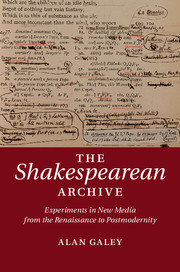 The Shakespearean Archive: Experiments in New Media from the Renaissance to Postmodernity (Cambridge University Press, 2014)
The Shakespearean Archive explores the entwined histories of Shakespeare’s texts and technologies of cultural memory over the past four centuries, and asks why we find Shakespeare so often associated with new media and with the idea of archiving itself. In a sequence of chapters dealing with the archive, the book, photography, sound, information, and databases, this book explores how the inherited texts of Shakespeare’s works became prototypical material for publishing experiments, new media projects, and tech demos, as well as for theories of information and computing from the seventeenth century to the present. Rather than taking current forms of computing to be the result of technical forces beyond the scope of humanist inquiry, this book offers a critical prehistory of digitization read through the afterlives of Shakespeare’s texts, examined from a perspective that combines elements of book history, media archaeology, and cultural history.
For samples of the book's topic and approach (and high-res digital images of some of the illustrations found in the book), see my three blog posts based on chapters from the book at The Floating Academy:
- The Victorian new media demo as a performance genre (based on Chapter 5)
- New media's ghosts: an experiment in composite photography (based on Chapter 4)
- Teena Rochfort Smith: the Ada Lovelace of the digital humanities (based on Chapter 1)
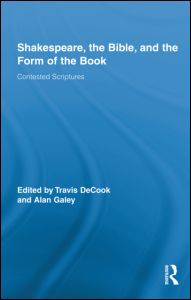 Shakespeare, the Bible, and the Form of the Book: Contested Scriptures (co-edited with Travis DeCook; Routledge, 2011)
Why do Shakespeare and the English Bible seem to have an inherent relationship with each other? How have these two monumental traditions in the history of the book functioned as mutually reinforcing sources of cultural authority? How do material books and related reading practices serve as specific sites of intersection between these two textual traditions? This collection makes a significant intervention in our understanding of Shakespeare, the Bible, and the role of textual materiality in the construction of cultural authority. Departing from conventional source study, it questions the often naturalized links between the Shakespearean and biblical corpora, examining instead the historically contingent ways these links have been forged. The volume brings together leading scholars in Shakespeare, book history, and the Bible as literature, whose essays converge on the question of Scripture as source versus Scripture as process—whether that scripture is biblical or Shakespearean—and in turn explore themes such as cultural authority, pedagogy, secularism, textual scholarship, and the materiality of texts. Covering an historical span from Shakespeare’s post-Reformation era to present-day Northern Ireland, the volume uncovers how Shakespeare and the Bible’s intertwined histories illuminate the enduring tensions between materiality and transcendence in the history of the book.- In addition to co-editing the Contested Scriptures collection above, I also contributed a chapter titled "The Tablets of the Law: Reading Hamlet with Scriptural Technologies."
- Architectures of the Book ArchBook is a collaborative, open-access reference resource for the history of the book, which focuses on intersections between the material form and information architecture of books.
- "Digital Archives and Their Margins." Panel co-organized with Katherine Harris (San José State U) for the Modern Language Association conference in Boston, January 2013. Detailed description and abstracts available here.
- "Networks of Deep Impression: Shakespeare and the History of Information." Shakespeare and New Media, ed. Katherine Rowe. Special issue of Shakespeare Quarterly 61.3 (2010). 289-312.
- This special issue represents the first time a major humanities journal has used online open peer-reivew. The whole experiment (including a draft of my paper) can be found at MediaCommons Press.
- The open peer-review experiment was covered in The Chronicle of Higher Education and the New York Times.
- "Mechanick Exercises: The Question of Technical Competence in Digital Scholarly Editing." Electronic Publishing: Politics and Pragmatics. Ed. Gabriel Egan. Toronto & Tempe, AZ: Iter/Arizona Centre for Medieval and Renaissance Studies, 2010. 81–101.
- "The Human Presence in Digital Artifacts." Text and Genre in Reconstruction: Effects of Digitalization on Ideas, Behaviours, Products, and Institutions. Ed. Willard McCarty. Oxford: Open Book, 2010. 93-117.
- full chapter in PDF
- publisher's page, including link to entire volume on Google Books
Other publications
- Alan Galey, Ellen Forget, and Charu Sharma. "Reading Fictional Worlds of Technology with Ursula Franklin: Fail-Safe and Constructed Realities." What Would Ursula Franklin Say? Ed. Kanishka Sikri, Katie MacKinnon, and Leslie Regan Shade. Toronto: McLuhan Centre for Culture & Technology, 2022.
- Alan Galey. "Reading McLuhan Reading Ulysses." Canadian Journal of Communication 44.4 (2019): 503-26.
- Alan Galey, Jon Bath, Rebecca Niles, and Richard Cunningham. "Imagining the Architectures of the Book: Textual Scholarship and the Digital Book Arts." Textual Cultures 7.2 (2012): 20-42.
- Wendy Duff, Emily Monks-Leeson, and Alan Galey. "Contexts Built and Found: A Pilot Study on the Process of Archival Meaning-Making." Archival Science 12.1 (2012): 69-92.
- Alan Galey and Stan Ruecker. "How a Prototype Argues." Literary and Linguistic Computing 24.5 (2010): 405-24.
TeachingAll courses are graduate-level unless otherwise noted
INF 330H: Born-Digital Culture
Undergraduate elective course for the Bachelor of Information program
The artifacts of contemporary culture are increasingly born digital, and they challenge us to understand how they work, what they mean, and how they might be curated for future generations. This course explores the production, transmission, and reception of born-digital artifacts, from music and image files, to memes, to Web content, to videogames and their paratexts, and other software. Primary analysis of digital artifacts themselves forms the core of the course, but the course also draws on fields such as media studies, bibliography, archival studies, internet history, and videogame studies to understand the infrastructures and social contexts that affect what will count as the future cultural heritage of the digital era. Guided by readings, lectures, and case studies, the course will enable students to explore questions that are currently facing digital preservation and curation within and beyond the academy. What does it mean to treat a video game as future cultural heritage? How is digital rights management shaping the born-digital cultural record? Who determines how digital materials are archived and curated for the future? How does understanding the materiality of digital objects affect social and power relationships in the present?
BKS 1001H: Introduction to Book History
A one-term graduate course, primarily for students in the collaborative program in Book History and Print Culture, introducing foundational concepts in book history, bibliography, editorial theory and practice, the sociology of texts, book production from manuscript through print to digital text, and the history of reading. Combines seminar discussions of key topics and case studies in book history with field trips to the Fisher Rare Book Library, Massey College Press, and Coach House Press. (Previously Books 1001 and its companion course, Books 1001, were taught as a single year-long course, Books 1000Y: Book History and Print Culture.)
BKS 1002H: Book History in Practice
This is one of the core courses for students in the Book History and Print Culture collaborative program, and serves as a follow-up to BKS 1001H: Introduction to Book History. The course consists of seminars on key topics in book history, punctuated by case studies of particular books, events, and debates. These case studies are designed to pull together ongoing threads of inquiry from the readings, and to allow students to work outward from specific artifacts to general questions. Students gain a detailed understanding of current topics in the field of book history, and how to situate their own research within ongoing debates. Topics for 2013 may include challenges to the idea of print culture, the book as imagined from the past, databases, orality and literacy, archives, paratextuality, authorship, and book history in the mainstream media. Case studies may include Charles Darwin, the Treaty of Waitangi, the Walt Whitman Archive, Joyce's Ulysses, the Penguin/Random House merger, and the New York Public Library's Central Branch redesign.
INF 2159H: Analytical and Historical Bibliography
This course examines books and other textual artifacts as material objects, focusing on methods of production and manufacture, and how they affect the transmission of texts. Students are introduced to theories and methods of bibliographical description and analysis, and to their application across a range of media. Classes cover the history of textual production, from hand-press to digital books, and its relevance to disciplines such as librarianship, digital curation, and digital humanities
INF 2331H: The Future of the Book
This course considers the history and possible futures of books in a digital world. In this course "the book" is interpreted broadly, meaning not just an object with covers and pages, but also an evolving metaphor for conceptual frameworks for knowledge, and a metonym that brings together many different technologies, institutions, and cultural practices. The course introduces students to interdisciplinary approaches such as book history, textual studies, history of reading, and digital humanities, with an emphasis on balancing theoretical speculation with practical implementation. Readings will survey topics such as the ontology of born-digital artifacts, critical assessment of digitization projects, collaborative knowledge work, reading devices (old and new), e-book interface design, text/image/multimedia relationships, theories and practices of markup, the gendering of technologies, the politics of digital archiving, the materiality of texts, and the epistemology of digital tools. Students will also receive a practical introduction to XML markup and visualization tools.
- Fall 2016 course blog & syllabus
- Winter 2021 syllabus
- Winter 2022 syllabus
- Winter 2023 syllabus
- Fall 2023 syllabus
INF 1501H: Culture & Technology I
This course is an introduction to various approaches that will help students understand and intervene in the culture-technology nexus. It is intended primarily as an orientation for students in the Culture & Technology concentration of the Masters of Information program, but it endeavours to provide knowledge and skills to any graduate student exploring Science & Technology Studies (STS), Critical Media Studies, or Digital Humanities. In the course, we explore diverse approaches that have been brought to bear on this rich and densely populated intersection. Philosophical, sociological, anthropological, historical, and literary questions are examined relying on a series of themes with broad resonance for students interested specifically in information and technology.