Grant McCracken
The Language of Clothing
In this article, McCracken
undermines the metaphor of “clothing as language,” arguing
that it obscures the ways in which objects convey meaning differently
than verbal communication. Rather than being read in a linear fashion,
material culture transmits meaning in a limited but more expressive way.
McCracken puts forth that objects can bring a physical presence to entrenched
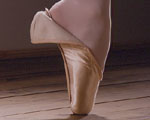
but unspoken ideas. The pointe shoe seems to be such an object. Many of
the factors that go into expanding McCracken’s theory provide useful
means of generating questions about pointe shoes and their potential for
revealing more about the culture that produces, consumes, and wears them.
What do pointe shoes and their use say about the individual wearer and
the society in which they are worn and accepted? I have chosen three aspects
of McCracken’s argument from which the most illuminating questions
arise: Systems of difference, Ritual and Rites of passage, and Individual
expression.
Systems of Difference
McCracken notes that notions of ‘difference’ can physically
manifest themselves in clothing and that many messages are expressed subtly
through objects since they cannot be explicitly stated through verbal
communication. Can this be said of pointe shoes? Only women wear pointe
shoes when they dance. Why don’t men? What about pointe shoes, and
the techniques they give rise to, make them unsuitable for men? Does this
mean that there are issues of gender at work here? As well, there is the
place of the dancer in society to consider. Do pointe shoes separate the
dancer from the rest of society in a particular way, marking out her "difference?"
Does this separation have gender implications? How does dancing en pointe
maintain or undermine prescribed notions of gender and "the dancer?"
These are all questions that will fuel my future research of this topic.
Ritual and Rites of Passage
McCracken discusses how clothing/objects reveal underlying meaning in
terms of denoting the rituals and rites of particular cultures. From personal
experience, I know how significant it is to receive your first pair of
pointe shoes. It signifies a shift in your ability as a dancer. As well,
the marring of the feet that occurs when you first wear pointe shoes becomes
a point of pride among dancers – the bravado of suffering for one’s
art. This seems to run parallel in the world of women’s footwear.
Stiletto heels, pointed toes, and narrow shanks all seem to be designed
to hurt the very part of the body that shoes purport to protect. Why would
women, dancer and non-dancers, go through this ritual of pain? Do non-dancers
take the same amount of pride in these self-inflicted wounds? What are
the objectives of such a seemingly masochistic undertaking? Is there a
"coming of age" implied in the ability to wear pointe shoes
and high heels?
Individual Expression
Early on in this article, McCracken asserts that material culture is an
expressive medium through which inward ideas are conveyed to the outside
world. Objects give us the opportunity to see how “culture is enacted
by individuals in their negotiation of daily life” (p. 61). This
concept is useful but through its failure to illuminate pointe shoes as
opposed to its success. Pointe shoes are homogenized objects that belong
more to the category of costume than clothing. Individual expression through
this object manifests itself inwardly rather than outwardly through the
marks the shoe makes upon the body (scars, calluses and blisters on the
foot) and vice versa (the subtle changes in the shape of the shoe as it
is stretched out). This idea may be useful when looking at the origin
of the pointe shoe. Who was the first individual to use pointe shoes?
Was it a collective shift or did one person begin the trend? In this way,
individual motive could be explored. Otherwise, pointe shoes are the common
tools of the trade, homogenous in colour, material and, for the most part,
design. This gives rise to questions about the similarities and differences
that exist between clothing and costume. Can costume be used in the same
way as clothing to resist or support social conventions or change?
The notion of individual expression, while not necessarily an aspect of
wearing pointe shoes, is an important element in dance. A dancer, who
may be seen purely as a vessel for the steps of a choreographer, uses
movement as a form of expression. Pointe shoes lend themselves to particular
kinds of expressive techniques for the dancer. What are these techniques
and to what ends do choreographers and dancers use them as a means of
expression?