JonathanRobinson
jon robinson [symbol] utoronto ca

Welcome
I now work as a lawyer in Toronto, but I continue to work on medieval topics that fall, roughly, within the ambit of legal and political thought. Before turning to law, I completed a Ph.D. at the University of Toronto in medieval studies and worked for time in academia. This website serves as repository of the work I have done and gives a sense of where some of my current research interests lie.
My pre-modern research interests focus especially on the intersection or legal and political thought in the thirteenth and fourteenth centuries. Following my doctoral work at the Centre for Medieval Studies at the University of Toronto, I spent two years as a post-doctoral researcher at the School of Canon Law at The Catholic University of America. At CUA, I expanded on my doctoral work in the history of the mendicant poverty controversy, particularly in relation to exploring what the texts of the controversy can tell us about how the origin and nature of property rights were understood. At the same time, I began to explore the medieval jurists' contribution to the concept of individual rights; Bartolus of Saxoferrato, the so-called iuris monarcha, was the nominal anchor of this new project, but it has since expanded into a more general exploration of thirteenth- and fourteenth-century developments. More generally, I have become interested in the relationship of individual rights (natural and positive) to natural and positive law.
Finally, if the 'location' of this webpage seems surprising, it is to be explained by the fact that the University of Toronto has not seen fit to complain about this page despite my increasingly tenuous connection to the University, and I'd like it to remain as a minor 'island of stability' among the short half-lives of many other web pages.
Publications
This is the one you want to bring with you to the beach and buy for all your friends and family:
-
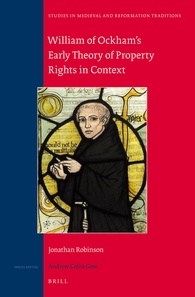 William
of Ockham's Early Theory of Property Rights in Context,
Studies in Medieval and Reformation Traditions 166 (Leiden: Brill,
2012), xxiii + 396 pp.
William
of Ockham's Early Theory of Property Rights in Context,
Studies in Medieval and Reformation Traditions 166 (Leiden: Brill,
2012), xxiii + 396 pp.
[ Table of Contents & Preface ] [ BibTeX ]
Reviews: Archivum franciscanum historicum 106.1-2 (2013): 223–226; The Journal of Ecclesiastical History 65.3 (2014): 675–676; Renaissance Quarterly 67.1 (2014): 240–242; Review of Politics 76.2 (2014): 327–330
For details concerning typos and errata, see here: [ TeX ] or [ PDF ]
Published articles and book chapters
Note that I now maintain e-prints (etc.) on the Open Science Framework, which is a proper open access respository (unlike social networking sites like Academia.edu, which should be avoided). However, for now (at least) what is available there is but a subset of what can be found here.
- 'Townshend v Townshend and Buttar v Buttar: Gifts, Intentions, and Exclusions', Canadian Journal of Family Law 30.2 (2017): 265–287.
- (with John Kilcullen) 'Medieval Political Thought', The Stanford Encyclopedia of Philosophy (Summer 2017 Edition), Edward N. Zalta (ed.), URL:
https://plato.stanford.edu/entries/medieval-political/. NB: John Kilcullen wrote the original version of this article, which he last updated in 2010; I substantively revised it for the summer 2017 edition, and now maintain it. Please contact me with references to and off- or e-prints of current and future scholarship!
[ forthcoming archived URL ] [ BibTeX ] - 'Ockham, the Sanctity of Rights, and the Canonists',
Bulletin of Medieval Canon Law
31 (2014): 147–204
[ paper ] [ BibTeX ] -
'Walter Chatton on Dominium,
History of Political Thought
35.4 (2014): 656–682
[ paper ] [ BibTeX ]
-
'Property Rights in the Shift from "Community" to "Michaelist"',
Rivista internazionale di diritto comune 22 (2011):
141–181
[ paper ] [ BibTeX ] -
'Innocent IV, John XXII, and the Michaelists on Corporate Poverty', in
Poverty and Prosperity in the Middle Ages and Renaissance, edited by
Anne Scott and Cynthia Kosso, Arizona Studies in the Middle Ages and the
Renaissance 19 (Turnhout: Brepols, 2012), 197–224
[ paper ] [ BibTeX ] -
'William of Ockham on the Right to (Ab-)Use Goods',
Franciscan Studies 67 (2009): 347–374
[ paper ] [ BibTeX ] -
'Qui praedicat periculum in illo peribit: William of
St-Amour's Anti-Mendicant Sermons', in
Weapons of Mass Instruction: Secular and Religious Institutions
Teaching the World, Proceedings of a St. Michael's College
Symposium (25-26 November 2005), edited by Joseph Goering, Francesco
Guardiani, and Giulio Silano (Ottawa:
Legas, 2008), 51-63
[ paper ] [ BibTeX ]
Reviews
Some book reviews (written in markdown):
- Review of Riccardo Saccenti, Debating Medieval Natural Law: A Survey (Notre Dame, IN: University of Notre Dame Press, 2016), for The Medieval Review 17.12.12 (also here)
- Review of Eckart Schütrumpf, The Earliest Translations of Aristotle's "Politics" and the Creation of Political Terminology, Morphomata Lectures Cologne 8 (Paderborn: Wilhelm Fink, 2014), for The Medieval Review 15.11.19 (also here)
- Review of C. H. Lawrence, The Friars: The Impact of the Mendicant Orders on Medieval Society Revised paperback edition (New York: I. B. Tauris, 2013), for The Medieval Review 14.04.22 (also here)
- Review of Jussi Varkemaa, Conrad Summenhart's Theory of Individual Rights (Leiden: Brill, 2012), for The Medieval Review 12.11.16 (also here)
- Review of James Blythe, The Life and Works of Tolomeo Fiadoni (Ptolemy of Lucca) and The Worldview and Thought of Tolomeo Fiadoni (Ptolemy of Lucca) (Turnhout: Brepols, 2009), for The Medieval Review 11.04.06 (also here)
 Please note that the above articles, essays, and reviews (in the form
they appear here) are licensed under a
Creative Commons Attribution-NonCommercial-NoDerivs 3.0 Unported License
. But I am probably willing to waive these restrictions for
certain creative repurposing, so just ask. (I can only imagine how many requests there will be….)
Please note that the above articles, essays, and reviews (in the form
they appear here) are licensed under a
Creative Commons Attribution-NonCommercial-NoDerivs 3.0 Unported License
. But I am probably willing to waive these restrictions for
certain creative repurposing, so just ask. (I can only imagine how many requests there will be….)
Translations
In what I now recognize as an example of structured procrastination, over the last few years I have translated a few texts pertaining to the mendicant poverty controversy of thirteenth and fourteenth centuries. I have since then widened my perspective some, with the goal of providing a series of texts that may be used in the classroom free of charge. However, I encourage students who wish to use anything from this website to speak to their professors beforehand.
I have aimed to provide literal rather than elegant translations, much like (one gets the sense) the original authors themselves aimed for clarity of expression over elegance. However, errors both small and large are no doubt present. If you notice any, I would appreciate it if you could let me know, no matter how trivial they may be.
These texts undergo sporadic revision at irregular intervals. Most of the time I remember to increment the 'version' number found at the bottom of the first page—so you can easily check which version is the newest—but I do forget occasionally. If the version number on the .pdf does not match the number list below, please contact me for the more recent version (and I can fix my mistake!).
Finally, those interested in other translations pertaining to the poverty controversy should visit the website of Professor John Kilcullen, first for translations of some of the relevant papal bulls, and for translations of some of William of Ockham's writings (and indeed much, much more).
- Bonagratia of Bergamo, A Tract on the Poverty of Christ and the Apostles [rev. 1.3b]
-
Bonaventure of Bagnoregio
- A Disputed Question on Evangelical Poverty as it Concerns Renunciation (De perfectione evangelica q. 2 a. 1 — De paupertate quoad abrenuntiationem) [rev. 1.4a]
- A Disputed Question on Evangelical Poverty as it Concerns Mendicancy (De perfectione evangelica q. 2 a. 2 — De paupertate quoad mendicitatem) [rev. 1.7a]
- Declaration of the 'Community' Regarding the Matter of Poor Use (ca. 1309–1310; 'Circa materiam') [rev. 1.0]
-
Michael of Cesena, The Shorter Appeal
(Appellatio abbreviata, extracta de Appellatione prolixa) [rev. 1.10a]
- This translation is based on Gál and Flood's edition (1996) of the Chronica by 'Nicholas the Minorite' (perhaps Nicholas of Freising), who compiled a large dossier of texts related to the controversy between the Michaelists and Pope John XXII. The text is available from the Franciscan Institute; some readers might be interested in a small list of minor corrections I have compiled.
- Peter (of John) Olivi, On Poverty and Revenue (Quaestiones de perfectione evangelica, q. 16) [rev. 1.1a]
- Walter Chatton, 'Whether Christ Merited by Lacking All Lordship to Temporal Things' (Reportatio 3.16.un) [rev. 1.1a]
-
William of Saint-Amour
- [William of St-Amour et al.[?], A List of Sententiae Taken from the Eternal Gospel by Professors of the University of Paris [rev. 1.1]
- A Disputed Question on the Quantity of Alms (De quantitate eleemosynae) [rev. 1.3a]
- A Disputed Question on Able-Bodied Begging (De valido mendicante) [rev. 1.3a]
- 'He Who Loves Danger...' (a sermon beginning 'Qui amat periculum') [rev. 1.5a]
- A Brief Tract on the Dangers of the Last Days (Tractatus brevis de periculis novissimorum temporum ex scripturis sumptus) [rev. 2.0a]
-
Papal Bulls (all pertaining to the mendicant poverty controversy)
- Pope Gregory IX, Quo elongati (Latin and English) [rev. 1.1]
- Pope Innocent IV
- Ordinem vestrum (Latin and English) [rev. 1.0]
- Quanto studiosius (Latin and English) [rev. 1.0]
- Pope Martin IV, Exultantes in Domino (Latin and English) [rev. 1.1]
-
Pope John XXII
- Quia nonnunquam (Latin and English) [rev. 1.4a]
- Ad conditorem canonum (both versions, Latin and English) [rev. 1.1e]
-
Bartolus of Saxoferrato
- On Guelfs and Ghibellines [rev. 1.0a]
- On the Government of a City [rev. 1.1]
- On the Tyrant [rev. 1.2]
- Huguccio Pisanus, On ius naturale (excerpts from his Summa decretorum)
- Peter Lombard, On Penance (Sentences 4 D. 14 cc. 74(1)–78(5)) [rev. 1.3]
- Tolomeo Fiadoni (Ptolemy of Lucca)(?), On the Origin, Translation, and State of the Roman Empire [rev. 1.0]
-
William of Ockham, Eight Questions on the Power of the
Pope.
Note: I have completed a draft translation of the full text, which I am in the process of revising. As it is in a state of flux, I have decided against posting any more drafts. Please contact me if you would like to see a draft of the full text.- Q.1: Whether the same person can have both supreme spiritual and secular power.
- Q.2: Whether supreme secular power has any special property unto itself directly from God.
-
Q.3: Whether it pertains, by Christ's institution, to the
pope and Roman Church to entrust temporal jurisdictions to
secular rulers.
Note: An earlier translation exists; see A.S. McGrade and J. Kilcullen, eds., A Letter to the Friars Minor and Other Writings (Cambridge, 1995) - Q.4: Whether the king or emperor of the Romans has full administration because his power comes directly from God.
- Q.5: Whether the king or emperor gains, via election, full administration because his power comes immediately from God.
- Q.6: Whether a hereditary king is subject to the person who crowns him.
- Q.7: Whether a king who succeeds hereditarily is subject in some way to the person who crowns him.
- Q.8: Whether a canonical election of the princes-electors would give to the one elected as king of the Romans, by virtue of the election, as much as legitimate succession gives to a king succeeding hereditarily.
 Please note that the above translations are licensed under a Creative Commons Attribution-NonCommercial-ShareAlike 3.0 Unported License.
(I am slowly updating the files themselves to reflect this.)
Please note that the above translations are licensed under a Creative Commons Attribution-NonCommercial-ShareAlike 3.0 Unported License.
(I am slowly updating the files themselves to reflect this.)
Texts
My new project, loosely speaking:
-
Bartolus of Saxoferrato, Liber decisionum minoricarum [rev. 1.6]
(Note: this text will be under considerable development for some time. Pay attention to the version number, and exercise considerable caution if you use it! — and of course I am happy to provide a more up-to-date version if you contact me.)
Below are a few texts, so far mainly only a few papal bulls, which I have found useful over the years to have lying around. I include them here because they are not already available online and I know I wish they had been. The bulls following are based on the versions found in the Bullarium franciscanum (Rome, 1759–1904). The Constitutiones are based on the versions found in Analecta franciscana 13 and 17, and the document is (as of May 2011) under active development.
- A partial comparison of the Franciscan Constitutiones generales (1260–1325). (Chapters 1–3) [rev. 1.2]
- Innocent IV, Nimis iniqua, 21 July 1245
-
Innocent IV, Ordinem vestrum, 14 November 1245(No longer maintained; see translations above.) -
Innocent IV, Quanto studiosius, 19 August 1247(See translations above.) -
Martin IV, Exultantes in Domino, 18 January 1283(See translations above.)
 Please note that, excluding the text of Bartolus, the other texts in
this section may be used pretty much as you please — otherwise
known as a
Creative
Commons Attribution-ShareAlike 3.0 Unported License.
Please note that, excluding the text of Bartolus, the other texts in
this section may be used pretty much as you please — otherwise
known as a
Creative
Commons Attribution-ShareAlike 3.0 Unported License.
Resources for Roman and Canon Law
Over the years I have found it handy to have plain text versions of the texts of the Corpus iuris civilis and (in part) the Corpus iuris canonici. They are no substitute for the standard critical editions, of course, but they are useful for many different reasons. This is especially true in the field of medieval law because of the way medieval jurists cited these texts. The ability to search and manipulate these texts has proven tremendously valuable. I have decided to make the versions I have used available on GitHub, which you can access by following this link. If you are familiar with Git, you can clone the repository:
git clone https://github.com/jonwrobinson/corpus-iuris
Others can download the set of files as a regular ZIP archive. (It can be found on GitHub as well: the link again.) Interested users of these texts should note that, depending on what I happen to be doing day-to-day, individual files may undergo rapid changes. (This is in fact the reason for using Git in the first place: it would be much too tedious to host up-to-date versions here.) Changes to the text itself are almost always very minor, except when removing some of the weird cruft that has survived the conversion from (sometimes spotty) HTML to the plain text versions I am maintaining, but the way they are organized does evolve. I am also very eager to hear about other texts to add to the collection if you happen to know of any.
If you are interested in contributing, Git makes it really easy for people to collaborate on a project and 'track changes'. For so large a collection of texts, this is useful because everyone can make minor edits that won't get lost or overwritten. And if you are not interested in contributing, you are advised to check back periodically and grab the latest version.
Miscellaneous
(If you have read this far...)
I try to use free software exclusively, and I encourage you to do so as well.
The files found on this website were written using the versatile text editor, Gnu Emacs, which is good for just about everything. Plain text documents documents are formatted in Markdown, which is a hardly noticeable markup language desgined for easy conversion to other formats (e.g., HTML). For more complex tasks, I use LaTeX, an extremely stable document markup language for TeX, a typesetting program (there are three common programs nowadays: pdfTeX, XeTeX, or LuaTeX). All PDFs created on this site were formatted using LaTeX, as was my book (with LuaTeX as the underlying engine). I encourage you to try it for yourselves and divest yourself of the limitations a traditional word processor forces upon you.
For what it's worth, I use GNU/Linux, usually a form of Ubuntu because it is free(!) and easy to use, and because I like the Apt system of package management. My preference is to maximize screen usage, avoid GUIs, and minimize the need for a mouse. I regularly use the following programs:
- Openbox: a lightweight, but highly customizable window manager
- tmux:
a terminal multiplexer, usually run in
a GNOME
terminal emulator, which commonly 'contains':
- An Emacs session (of course)
- mutt: my email client (along with offlineimap, notmuch, etc.)
- Ncmpcpp: a terminal based front-end for MPD
- One or more instances of Bash
- Tilda: because it is cool and convenient
- MPD: for music (made infinitely more useful by this goodsong script)
- PDF: MuPDF and zathura
- Conkeror: a keyboard-driven, highly-customizable, and highly-extensible web browser
- Other useful odds and ends include: conky, dmenu dzen2, and tint2.
